>'Sure AI won't perform as well as our human tutors with all the support behind them, but it's also $30 a month.'
For how long, though.
>Mr Buckland also claimed the tutoring industry doesn't 'actually do anything unique' but instead provides comfort to students - something AI can replicate.
Jesus. That's really not a good thing.
It's not every day you see someone so incredibly dismissive of the product they're selling themselves.
> It's not every day you see someone so incredibly dismissive of the product they're selling themselves.
I believe that considering that AI is much cheaper than their service offering, and thus customers of Dymocks Tutoring and Talent 100 often ask them how much more they are actually offering for the much more expensive price has put this company under a lot of price pressure from customers.
So, I bet that Dymocks Tutoring and Talent 100 wants to change their main service offering to target parents from rich families instead who aren't so stingy.
They can't do that because a CMS under Cloudflare needs to be configured to bust the Cloudflare cache when content is edited or the user will see cached content after they edit a page.
That might be the default configuration if your CMS doesn't return any cache-control headers. But Cloudflare definitely [0] supports must-revalidate and etag or last-modified, which is also probably supported by whatever CMS you're using. HTTP conditional requests are very old and very widely supported.
[0] Okay, my claim is only definite up to my memory of using Cloudflare for a fairly high-traffic circa 2019-2022. I haven't used Cloudflare after that point, but a quick search of their docs shows support
Right. But if the cache MUST be revalidated every time, it's the same thing as being disabled.
The point of a reverse proxy is to reduce load on the server rendering the page. If you GET, the page is rendered. So in order for etag/last-modified to be effective, the CMS must implement HEAD. If the CMS doesn't implement HEAD or implements it in a way that ends up doing all the work of GET anyway, you just end up with more load than just doing a GET every time.
The funny thing is that the way HTTP is designed the simplest PHP script can do this correctly, because the server must send the headers first, so a PHP script can NOT do the work to generate the HTML until it has sent the correct headers, as they won't be able to change the headers after they start sending the body. In theory, the process could just shut down the instant the first body byte starts being sent and save work in a HEAD request. The problem is that pretty much everything works in a more "clever" way: you have some sort of template engine that generates the whole HTML, a view method that makes the DB calls, etc., and only after all the work is done the HTTP headers are sent. Because this method allows the backend to add/change/remove headers at any point during the process, not just at the start.
Essentially the problem is that CF doesn't know what your server is running, and even an s-maxage=60 is going to look like a bug from the user's perspective if they go to /post?id=123, navigate to /edit-post?id=123, edit the post, go back to /post?id=123 and see the post unchanged.
What are you referring to with the origin needing to support HEAD requests? For HTTP conditional requests your origin just needs to support GET with if-none-match or if-modified-since. Then it responds with a 304 with no body if the cached version is still valid. The origin should, of course, be able to determine cache validity much more cheaply than rendering the whole page, which is usually as simple as checking a single timestamp in the database.
And, of course, you can still use cache-control to permit some duration of staleness, so that you don’t literally revalidate on every request.
Nuclear power is not a renewable power source in the technical correct meaning of the word. Fission material is "only" abundant, in that we can win nuclear fission material from many sources, including recycling spent nuclear material, but it is not available and spent without human intervention (otherwise we could argue fossil fuels are renewables, too).
As an aside, nuclear fission power differs from renewable power in many other ways, too. It is not clean, it is not easy to harvest, it is not safe, it is not cheap, it is not a mass job engine, it is not low-maintenance, it has less utility, and it has less flexibility.
IF the world got its primary energy from today's kind of light water reactors, uranium available at up to 3x the current price would only last for about five years.
A fully nuclear-powered world (including all energy use, not just grid electricity) would need breeding of some kind; otherwise the uranium just gets too expensive. So when you hear people claiming nuclear is cheap, ask them if that cheapness includes the technologies that would actually be needed for nuclear to do the full job.
If we needed more nuclear fuel we would be producing more of it. Comparing current production to a world where we use a thousand times more of it is ridiculous. Uranium is not that rare, and spent fuel rods still have well over 90% of their potency so they can be recycled.
Nuclear energy could easily power the entire planet for thousands of years.
Sure, we could produce more. It would have to be from much lower grade ores, and so would be much more expensive and disruptive. This is why breeding would be needed, so the cost of the uranium would not make nuclear even more unaffordable than it already is.
The argument about affordability is quite ridiculous in a world that is becoming uninhabitable as a direct cause of the "affordable" alternatives.
We could easily afford to use nuclear, and we wouldn't have to rely on it entirely - we have many alternatives such as solar, wind, hydro, geothermal etc. I'm also quite confident that economy of scale would improve the fuel cost, and the higher investment would make breeding and other nuclear technology advancements much quicker than they are and have been. Not to mention fuel cost is quite insignificant in nuclear energy.
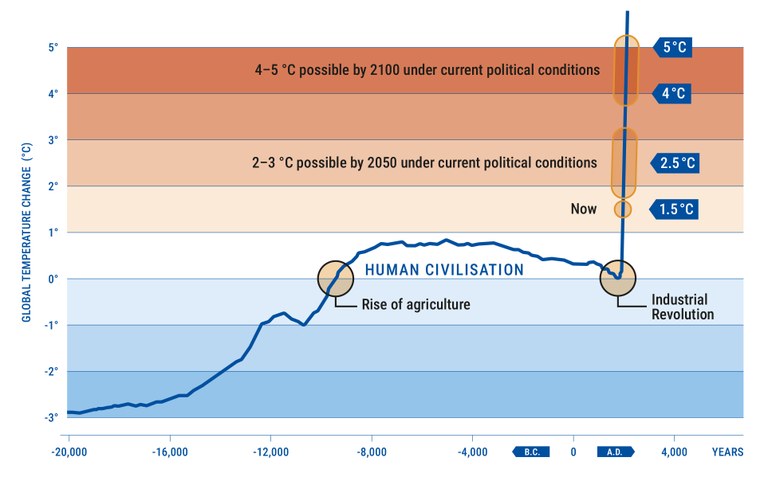
We can however not afford the consequences of fossil fuels. We are already severely impacted by global warming and it will get much worse very quickly. I think this chart conveys the severity of our situation very well: https://www.dpg-physik.de/veroeffentlichungen/publikationen/...
Affordability most definitely figures into which avenue forward should be taken. It cannot be used to justify fossil fuels over nuclear, but it can be used to justify renewables instead of nuclear.
Nuclear doesn't have a "get out of economics free" card just because fossil fuels are to be eliminated. I understand the desire of nuclear fans to pretend otherwise.
I'm not a "nuclear fan", I'm a "don't destroy the planet fan". I'm not saying we should build nuclear instead of renewables, I'm saying we should build it instead of fossil fueled generation. It seems you agree with this, so I'm not sure why you seem to be arguing against it.
Until the day that we stop burning fossil fuels entirely, we should be building nuclear to replace it. If it's more expensive that's fine, I don't think it would be, at least not significantly, but I can't prove it and I don't care either way, it doesn't matter. What matters is replacing fossil fuels as fast as possible. It's probably already too late, and the powers that be don't give a shit anyway so none of this will actually happen but this is what we should do.
I'm not sure I understand. That's the main pre-condition... to include an arbitrary PHP that is already in the server.
On a fresh WP install, a random user can't upload PHP files. Normally you don't even need to allow random users to register an account since avatars on comments come from gravatar anyway.
> On a fresh WP install, a random user can't upload PHP files.
Indeed, but you don't need to upload anything as long as there's already a PHP file that allows you to execute arbitrary commands somewhere on the server, right?
Well, as it turns out, the default PHP Docker image has had such a file readily available until version 8.5 =)
Jesus. I don't think WP is nice to use, but people are saying WP is crap because someone else made pearcmd.php that allows you to run arbitrary commands, and then a third someone else included that in the default PHP docker image. In this case all PHP CMS's are a directory traversal bug away from this CVE.
Indeed. Then again, it's on WordPress not to have directory traversal flaws in their core functions...
- especially the functions that are explicitely exposed to be used on front-facing interfaces (ie: templating functions).
- and especially when the security flaw in question was not only raised 9 years ago but described in details on the official documentation page of the affected function
I really can't tell if you mean "Explorer.exe is good enough and I never felt like it needed improvement" or "Oh, I can make anything I want to, with free tools? This is great! I'll make a file manager for my personal usage that's perfect for me."
The former. You use one DE, typeahead triggers full text search. You use another, no metadata like image width/height when selecting images. You use a third one, no folder thumbnails.
It's baffling that you can't see that what OP is getting at is that there is not in fact any 'file manager he likes'. 50 half baked solutions are just that - half baked solutions.
"Just learn hundreds of different tools, spend dozens of hours reading all their man pages, understand all their limitations, and pick the correct one before starting your task, all so you can accomplish something completely ancillary to the task you actually want done. Geez, it's not hard."
Unfortunately, just because you have choices that doesn't mean those choices are good.
I was forced to the file explorer on Windows, and the file explorer was good so I didn't mind. I was also forced to use MS Paint. And it was good for a long time, until they added layers. Now my primary use case of it (pasting an image and cropping it) doesn't work as well as it used to.
On Linux I don't even have that choice. There are choices, yes, but none of them do what I want anyway.
What truly drives me insane is that if you say "I just want what Windows does" people tell you that it's not Windows, it's "different(tm)." Then you ask why do Linux software sucks in comparison to Windows, and you get told "well, it's because Windows has $ to spend in R&D." So it's double-think. Developers are aware proprietary software spends tons of money they don't have in R&D, and yet they shy away from just copying the results because they don't want to be Windows.
I just want Windows, but with freedom. I don't want "different" if it's not going to be better.
> Then you ask why do Linux software sucks in comparison to Windows, and you get told "well, it's because Windows has $ to spend in R&D."
Are there actually people who claim this? Microsoft has plenty of money but the premise that they use it to improve the user experience seems contrary to evidence.
When something sucks on Linux with no alternatives it's usually because most people don't use the feature you want, e.g. because there is another way to do the same thing and more people are doing it that way, and then no one bothers to make thing you want because their desire to have that is already being satisfied by something else.
Of course, one of the choices you have is to build the thing you want yourself, which is why it works out that way. The chances of someone having done that go up the more people want it to exist. When the number is low, you have to decide if you want it enough for the person who makes it for everyone to be you. And it's fine if your answer is no, but now you know why that thing doesn't exist.
"Choice is bad because I might have opinions and then instead of the computer saying no I might switch to software that better suits my preferences. I just want a corporation to tell me what to want"
It’s more like, “I already have opinions and preferences and despite the various options available, none of them suit me well and so choosing any one results in a high degree of compromise, and so the next best thing is using a different one depending on the circumstance which brings its own compromises.”
Someone did though. Otherwise they wouldn't have created FilePilot. I have never had issues with any file manager in Linux. Explorer on the other hand is annoying as heck. Of course I am not picky with a file manager as I rarely use it on Linux anyway.
But what if they update the webpage to something completely different from what you bookmarked? Wouldn't you like to have access to the most up-to-date version always? /s
Writing is pretty hard for a lot of people, maybe especially so if they are more non-verbal thinkers, and then doubly so again if one must write not in one's native language.
Depends on the writing. Writing a blog post or something is challenging because you want to have an engaging style. But I see people at work using LLMs to fill out tickets, which is the easiest thing in the world. It's just a plain description of things, it requires no skill at writing at all. It baffles me that people are using LLMs for something like that, which should take less than a minute of your time to fill out and will be more pleasant for the recipient than the slop the model produces.
Here I would maybe argue that the simplicity makes these kinds of tasks tedious (like doing taxes), so it also makes a lot of sense for people to want to just throw AI at it. Tedious, easy rote tasks can be much more unpleasant than engaging ones.
I think people massively over-rely on AI and I really worry about the consequences of this. But there is nothing baffling at all about the basic appeal, IMO.
I don't think I have to speculate why comments like yours get downvoted so much.
Anyway, I completely agree. Writing isn't something to be delegated.
The problem is not new with LLMs. Businesses have been delegating writing to idiots who don't really care for the entire history of business. Authors and musicians have traded their souls for inauthentic crowd-pleasing results for about as long.
No, the problem with LLMs is that people are all using the same generic models. This only further shows that the future of LLMs is locally trained and locally run. Personal LLMs on a personal computer. Business LLMs on-prem. We will continue see them flourish in ways that generate absolutely no money whatsoever on their own, but do add marginal value when combined with a heavy dose of human creativity.
All the clueless old farts that are still alive by this point will continue to lecture the rest of us with more condescending gee whiz "whaddyaknow" and "whodathunkit" nonsense. As if they've even had their finger on the pulse since the early 2000s.
    while (i < cursors.len) {
        if (actual_index < arr.items.len) { cursors[i] = .{...}; i += 1; }
        else iteration.remove(i);
    }
I think you have to be a special kind of person to call Rust "more readable."
The thing about Rust is that if you can appreciate zero-cost abstractions on iterators then the language feels like the only right way to program. But many programmers either don't use this sort of programming at all, or don't care if it has a cost in languages like JS, Python, Java, etc.
Personally I like Zig a lot because it feels like you're doing low-level programming but without having to program C which is... well, https://xkcd.com/918/


For how long, though.
>Mr Buckland also claimed the tutoring industry doesn't 'actually do anything unique' but instead provides comfort to students - something AI can replicate.
Jesus. That's really not a good thing.
It's not every day you see someone so incredibly dismissive of the product they're selling themselves.
reply